Industry
Aerating, Composting, Crushing, Mixing, Screening
Application
Aerating
Function
Aerating, Composting, Crushing, Screening, Mixing
Model
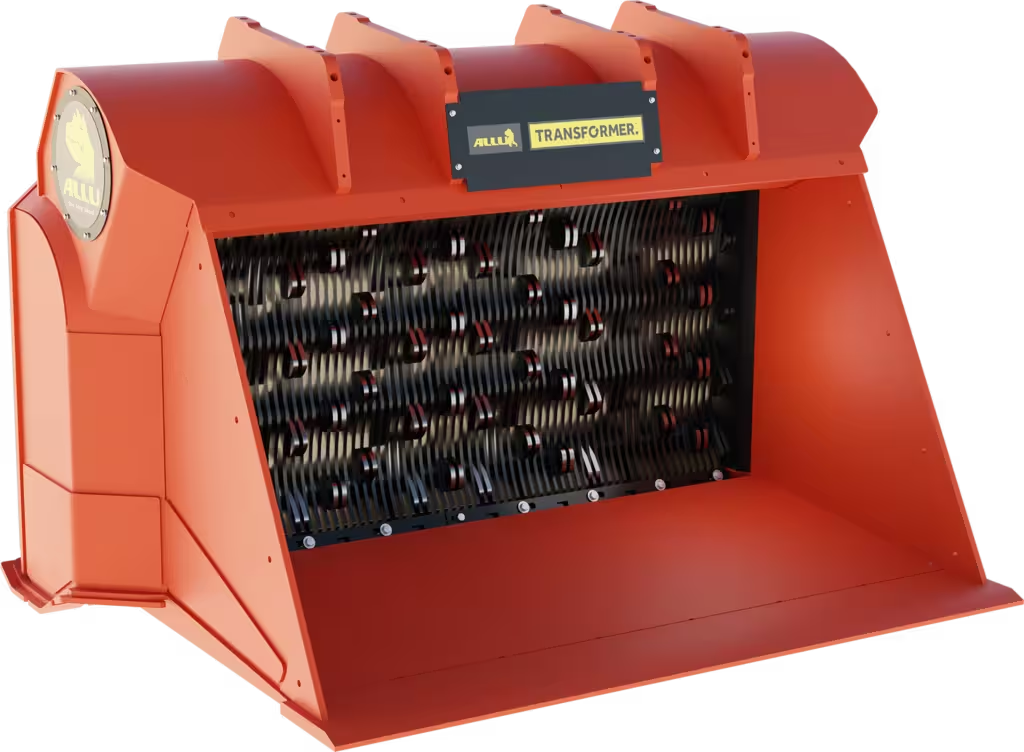
ALLU Transformer DS 4-23 screener crusher with XHD60 blades
Problem
Wet, lumpy contaminated sludge material was causing delays to the composting process of a Swedish company.
Solution
The material was screened, shredded and aerated using an ALLU Transformer screening bucket which enabled composting to be accomplished more quickly, effectively and efficiently.
Benefit
The entire composting operation is no longer hindered by wet clumps of sludge. The process is now more efficient as all screening, shredding and aerating is done in a one-step operation, making composting and material reuse faster and more effective. TRANSFORMING YOUR EFFICIENCY.
Related Products
Screening Bucket – D-Series
Versatile DN-, DS-, and DH-Series Screening Buckets serve in a wide range of applications, ensuring high-quality material processing on-site.
ALLU Soil Improvement System Stabilising Evacuation Road Foundation
USA
Material
Swamp, rich on peat and vegetation
Industry
Mixing, Stabilising
Application
Stabilising
Function
Stabilising, Mixing
Model
ALLU Soil Improvement Complete System
Problem
An existing two-lane Miami highway was to be expanded into four-lanes so that it was better suited for any necessary evacuation of the locale. The length of the road was approximately 9 miles (15 km), with its width increasing from 40 ft. to 60 ft. (from 12 to 20 m). Material to be processed in order to expand the highway included parts of a swamp, peat, decomposing vegetation, and fresh vegetation, as well as wet sand.
Solution
In order for the highway to be expanded safely and efficiently, the project required stabilization to depth of 12 ft. (4m). The ALLU Soil Improvement System stabilized the ground in situ in an environmentally friendly way.
Benefit
The ALLU Soil Improvement System increased the road’s bearing capacity and safety. In addition, the contractor benefited from savings in time and money with no need to bring in new materials due to the efficient and effective re-use of existing materials.
Related Products
PF 7+7 Pressure Feeder
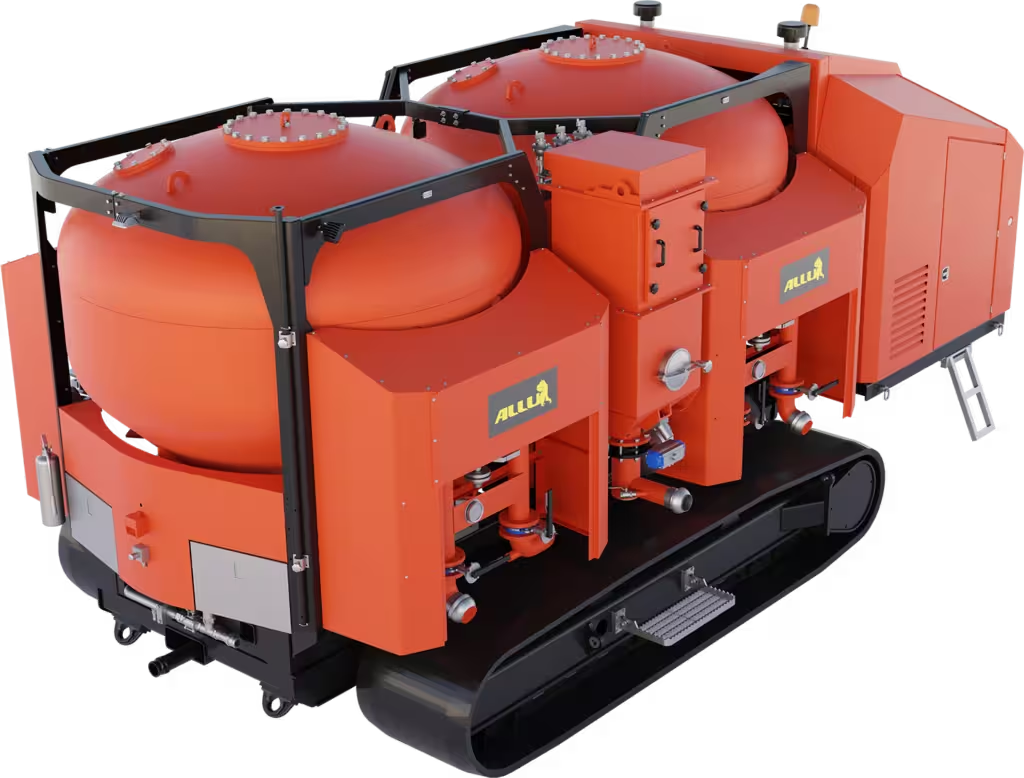
The double tank ALLU Pressure Feeder PF 7+7 NextGen allows for continuous feeding and precise dosing of dry binders in soil improvement projects.
ALLU Soil Improvement System Stabilising Railway Foundation
Sweden
Material
Swamp, soft peat and clay
Industry
Mixing, Solidification, Stabilising
Application
Stabilising
Function
Stabilising, Solidification, Mixing
Model
ALLU Soil Improvement System
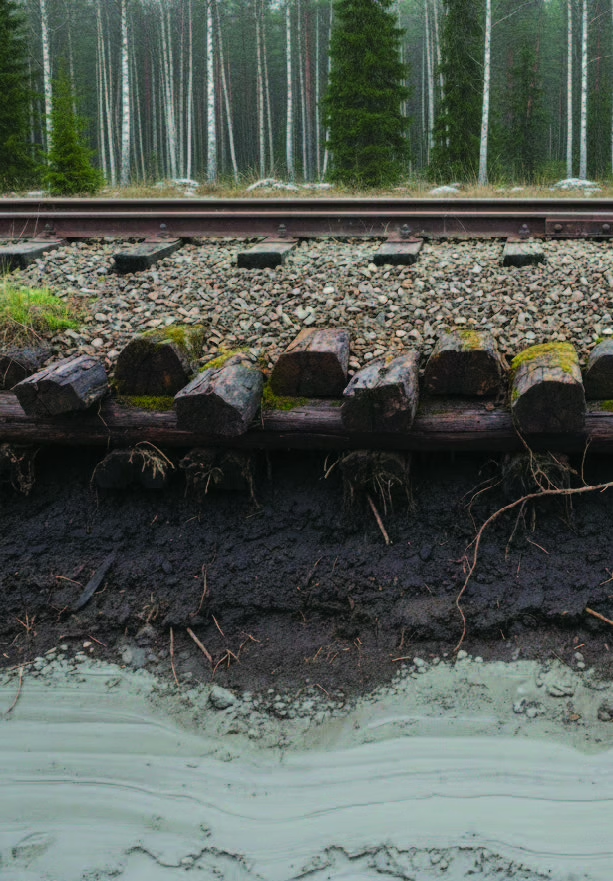
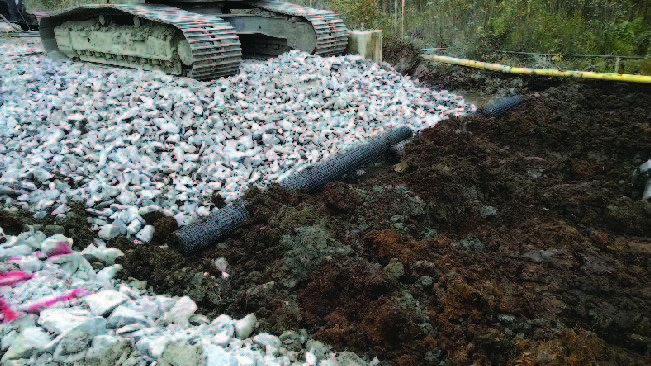
Image for illustrative purposes only.
The Lindholmen–Frösunda section of the Roslagsbanan commuter line runs across peat bogs and very soft clay north of Stockholm. The original early 1900s railway sat on a simple timber mattress, a layer of logs acting like a crude geotextile. It hadn’t settled much, but it had a bigger problem: “THE WHOLE AREA BOUNCED WHEN A TRAIN PASSED”
PROJECT SPECIFICATIONS
750m
Long single track on peat and soft clay, stabilized before track rebuild
3-4m deep
Mixing through peat into upper clay
10m wide
Stabilised width under single-track embankment
>50kPa
Target strength, undrained sheer strength
Overview: A “Bouncy” Railway on Peat
Dynamic movements limited permitted speed, increased maintenance, and were unacceptable for a major capacity upgrade. At the same time, designers faced tight constraints:
HIGHLY ORGANIC SOILS: 1–4 m of peat over very soft, sensitive clay(undrained shear strength ~4–5 kpa).
ENVIRONMENTAL PRESSURE: Peat excavation would mean large spoil volumes, co2 release and impact to nearby wetlands.
LIMITED CORRIDOR: Lake on one side, cycle path on the other; no room for wide excavations or a big temporary works zone.
BUSY COMMUTER LINE: About 53,000 daily passengers on roslagsbanan overall – shutdowns had to be short.
Faced with a narrow corridor squeezed between a lake and a pedestrian path, deep peat and very soft clay, and only short shutdown windows on a busy commuter line, the project team quickly saw the drawbacks of traditional solutions. Mass excavation and replacement would have meant large spoil volumes, stability risks during digging, long closures and a heavy environmental footprint, while pile-supported slabs pushed costs and construction complexity beyond what the project could reasonably carry. What they needed instead was a method that could fit within the existing alignment, reuse the soil in place, minimise traffic disruption and still deliver a stiff, durable track foundation.
The obvious candidate was in-situ mass stabilization with dry mixing. Instead of fighting the peat and clay with heavy excavation or deep foundations, the idea is to turn the existing soil into a controlled engineering material right where it lies. By blending a carefully selected dry binder into the soft ground, designers can “dial in” the strength and stiffness needed for modern train speeds while keeping settlements within limits. Because the treatment follows the existing alignment, it fits inside tight corridors without widening the embankment or disturbing adjacent assets. And by reusing the soil in place, it cuts spoil, truck movements and carbon. In short, dry-mix mass stabilization promised performance, constructability and environmental benefits in one package.
The better way
In-situ Mass Stabilization with dry mixing
The geotechnical team selected in-situ mass stabilization with dry soil mixing as the preferred solution. A contractor executed the works using the latest ALLU Soil Improvement equipment: The concept: build a stiff, continuous “mattress” of treated peat and clay under the future track, instead of removing the problematic soil.
Key geotechnical design targets
3 meters
mixing depth through peat track embankment into upper clay
The design targets for the stabilized ground were clear. First, the bearing capacity had to be increased so the embankment could carry train loads without excessive deformation. Second, settlements and long-term consolidation needed to be tightly controlled: because the existing track profile could not be raised, total settlement of the stabilized ground had to be limited to only a few centimeters. Third, the dynamic stiffness of the formation had to be improved to eliminate “bouncing” under passing trains and maintain good track geometry. Finally, the solution needed to provide adequate slope stability, with a safety factor greater than 1.5 against shear failure in both the embankment and adjacent slopes.
Binder recipe
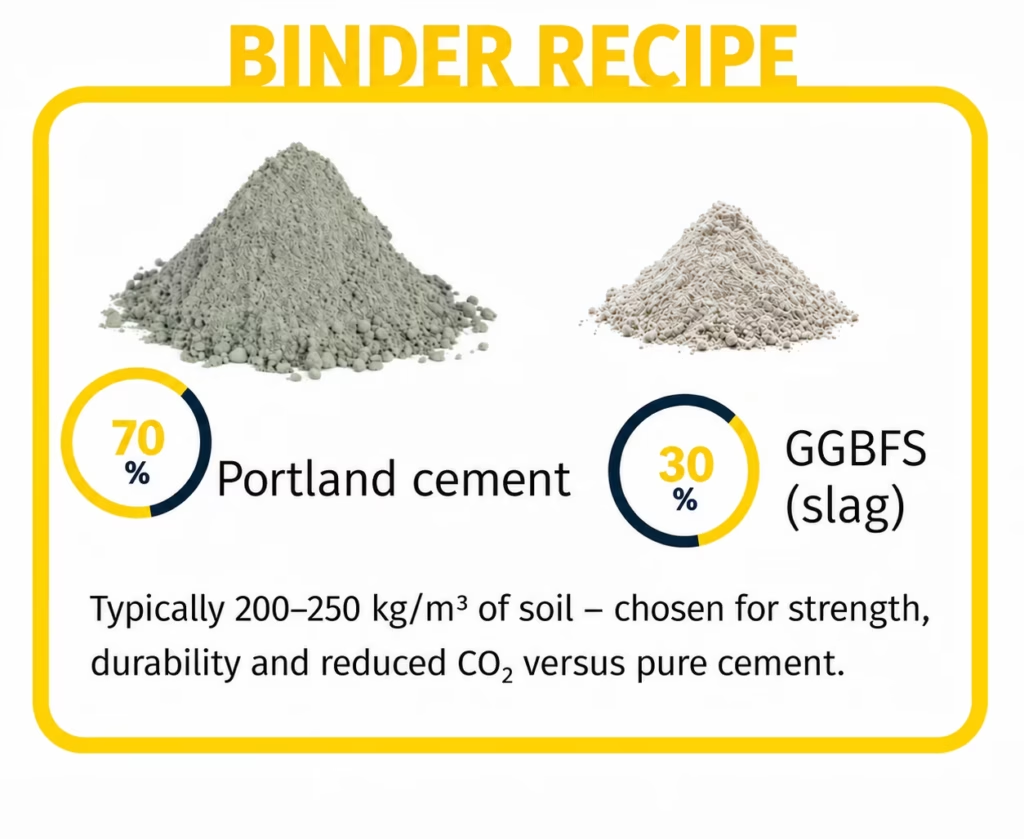
The binder recipe was chosen to match both the soil conditions and the project goals. Laboratory and field trials on Roslagsbanan, including earlier works at Täljö, had already shown that a 70 % Portland cement / 30 % ground granulated blast-furnace slag mix at around 200 kg/m³ comfortably exceeded the required strength for similar peat and clay deposits. Building on this experience, the Vallentuna design adopted the same blend and dosage range, confirming with cube tests that the mix achieved the target UCS and shear strength. The 70 % cement fraction provides rapid early strength so the line can reopen quickly, while the 30 % slag contributes continued strength gain and long-term durability and at the same time lowers CO2 emissions compared with pure cement. Lime was deliberately excluded: the highly organic peat contains very little clay, so there is limited potential for lime–clay reactions, whereas cement and slag are effective binders for such soils. Overall, the chosen recipe provided a proven balance of performance, constructability and sustainability for this soft-ground railway upgrade.
Laboratory and in-situ test panels confirmed that this binder blend met and exceeded performance requirements.
HOW THE WORK WAS DONE
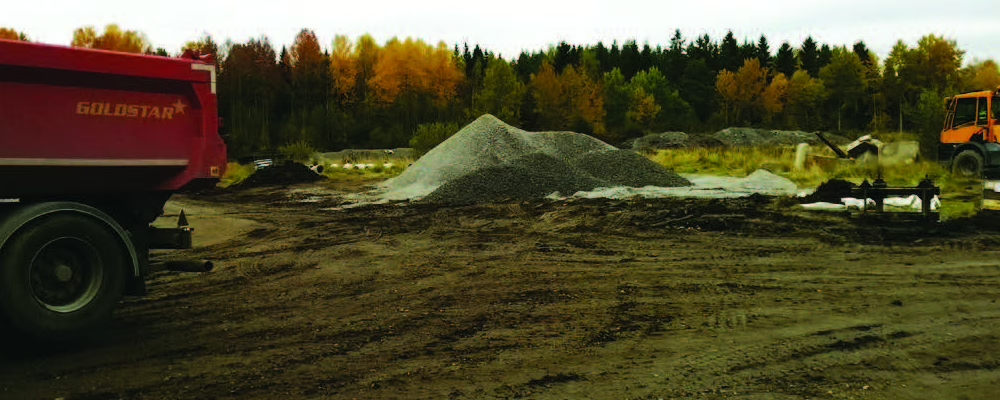
Strip and access: Existing track, ballast and the old timber mattress were removed. A geotextile + crushed rock working platform allowed machines to traffic the bog.
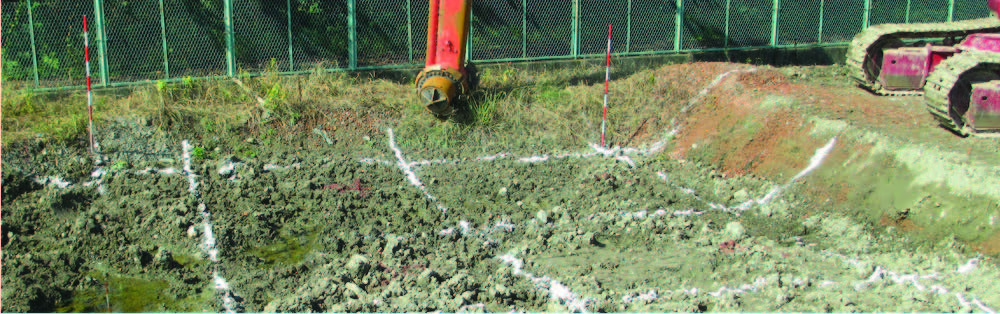
Divide into cells for control & speed: The peat area was set out in 5 × 5 m cells (25 m²) using GPS – an easy way to manage binder quantities and ensure full coverage.
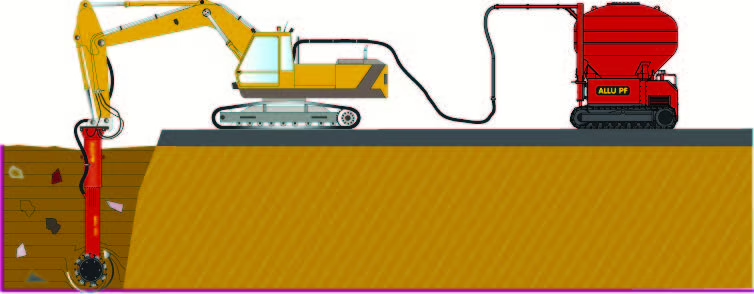
Mix in three passes with ALLU PMX + PF: The PMX mixer was driven down to design depth while the PF feeder injected dry binder. Two further shorter passes blended soil and binder into a homogeneous mass. In fully saturated peat, little or no extra water was needed. Two PF feeders were used in rotation – while one worked, the other was refilled – keeping production continuous.
Surface prep and reinforce: The treated surface was trimmed; then a separator geotextile, geogrid and new crushed rock ballast.
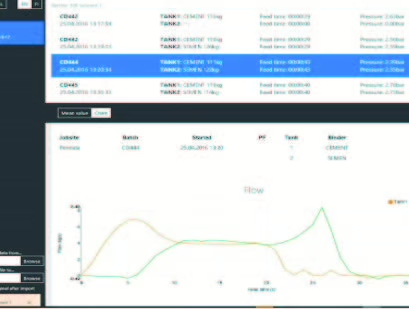
Quality control built-in: Automated logging of binder weight vs. depth for every cell Field vane tests after 1–2 weeks Cored samples for 7- and 28-day UCS tests Acceptance criteria: UCS ≥ 100 kPa and consistent mixing. Achieved strengths were typically 120–150 kPa at 28 days, comfortably above target.
THE OUTCOME
Track strengthening completed within the planned shutdown window
16,500 m³ of peat and soft clay stabilized in situ
750 m of track treated, 10 m wide stabilised layer, 3 m typical mixing depth depth
~300 cells of 25 m² each
24 t binder per cell, three 8 t loads from the PF feeder
~650 m³ per 10-hour shift production with a three-person crew
Compared with excavation and replacement, this avoided moving roughly 16,500 m³ of peat and clay off site and importing the same volume of granular fill – thousands of truck movements and significant CO² emissions avoided. After stabilization and reconstruction, the Lindholmen–Frösunda single track reopened with: No more “rocking” embankment – dynamic deflections under trains essentially eliminated, minimal settlements – only a few millimetres, within design expectations, improved track stiffness and reduced maintenance need, a fast, cost-effective solution compared with pile slabs or mass excavation and a lower-carbon, lower-impact project by reusing in-situ soils and incorporating slag in the binder.
Why This Matters for Your Next Soft-Soil Project
For designers and project managers working on rail, road or industrial platforms over peat and soft clays, this project demonstrates that there is a better way to do things:
Design for stiffness, not just settlement. If you only design for settlement, a track can still feel soft and “bouncy,” limiting speed and driving up maintenance. What really matters for rail performance is stiffness under moving loads. ALLU mass stabilisation lets you build that stiffness into the ground.
Use the soil you have. Instead of fighting the peat, the team turned it into a structural material. That meant fewer trucks, less risk of slope instability, fewer permits, and a smaller CO2 footprint.
Plan production like a factory process. Breaking the site into 25 m² cells, combining layout with ALLU’s dosing control and using two PF feeders gave reliable outputs (~650 m³/shift) with a very small crew – a big advantage on tight shutdown schedules.
Keep QC simple but strict. Inline binder logging a small set of field and lab tests were enough to prove performance without overcomplicating the site setup.
Choose equipment that fits the corridor. The ALLU PMX mixer or the ALLU PMV Processor work from a standard excavator and a narrow working platform—ideal where you can’t widen the the embankment.