As well as improving efficiency in material processing, ALLU Transformer buckets help businesses transform their green credentials.
With ALLU Transformers excavated waste materials are transformed into valuable materials and reused on site instead of sending to landfill. Less transportation of materials, less fuel consumption, less landfill and recycling of waste materials are all steps that support environmental sustainability.
Substantial savings are also accomplished in the form of lower haulage costs and landfill fees. As the Transformers facilitate the more efficient utilisation of waste materials, the need to purchase replacement materials is reduced and recycling the left-over materials can generate an income.
Sorting and processing of green waste, compost materials and construction waste with ALLU will reduce environmental impact and improve the bottom line.
Efficient Material Processing Allu
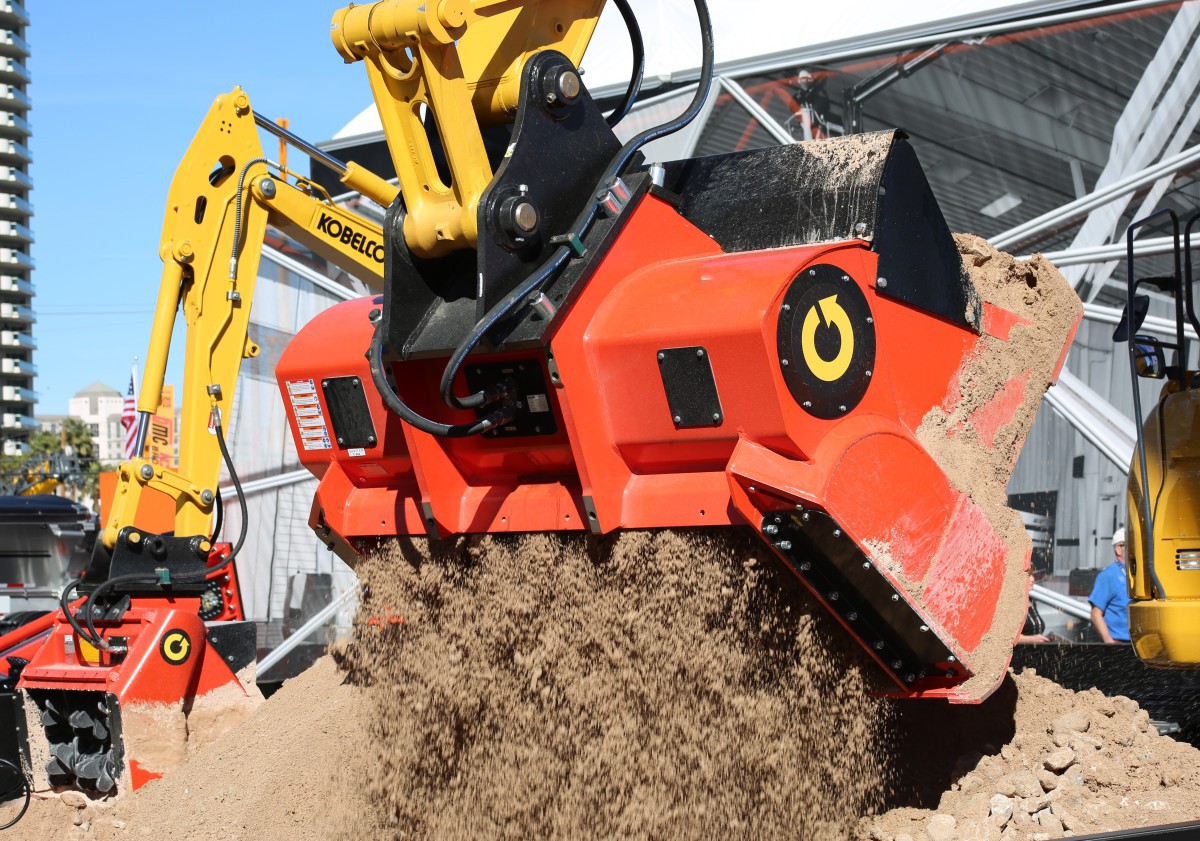
Transformers are purpose built for efficient material processing by reducing the number of process steps needed and transforming waste into useable material. ALLU Transformer buckets provide a one-stop-shop process by transforming any carrier; excavator, wheel loader, skid steer etc. into a multifunctional tool that will screen, process, mix, aerate, pulverise and load – all in a one-step operation.
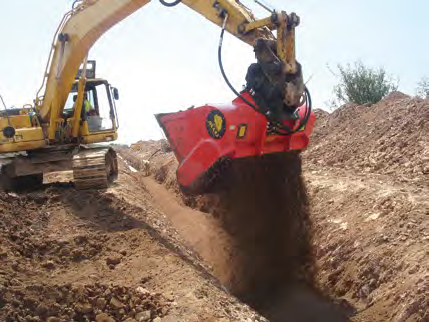
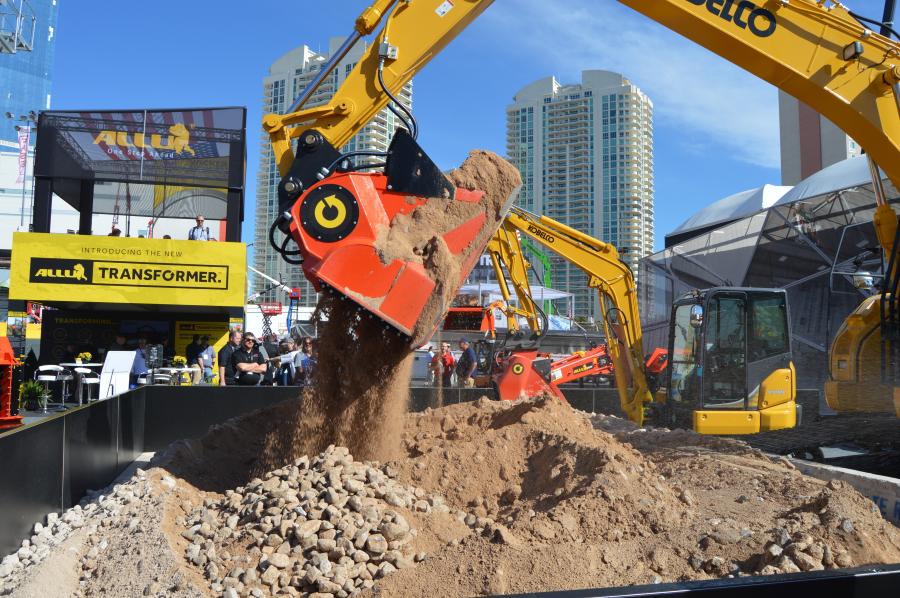
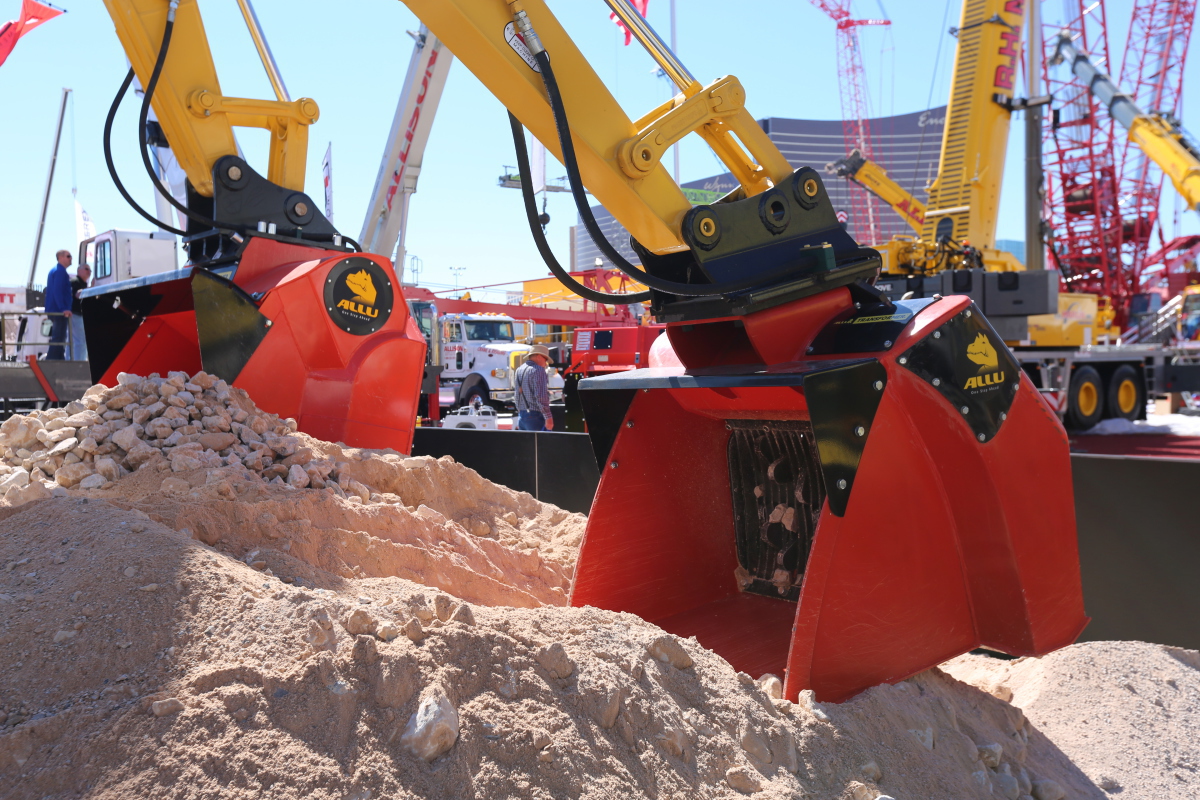
As the Transformer bucket begins processing, the undersize material falls through the bottom screen and can be tipped directly into a truck or processing plant. The oversize remains in the bucket and can be tipped onto a stockpile. An added bonus is the bucket’s ability to handle wet material without clogging, which is often a serious challenge in clay-bound areas.
Blade thicknesses determine the fragment size of the end-product and ALLU has a range of blades than can easily be changed onsite to produce required fragment sizes.
ALLU units fit for almost any base machine, excavators, loaders and skid steers from 8t to 160t.
Minimised Downtime With Allu Mobile App
Using IoT technology, the ALLU App provides information about the working hours and instructions to guide the operator through safe working methods such as the right angle of inclination when using the ALLU attachment throughout the whole operating and ownership process.
In order to maintain maximum productivity on the site and to minimise equipment downtime, the ALLU Mobile Application (ALLU App) provides information about the ideal maintenance frequency and the changing of wear parts, based on the number of working hours.
Australia-Wide Network
Sales, parts and servicing of the ALLU Transformers is taken care of by a dedicated dealer in each state. The network includes:
ALLU will be exhibiting equipment from its world class equipment ranges. As well as established and proven equipment, ALLU will be unveiling its latest developments, including launching the new ALLU crusher and exciting solutions. ALLU aims to be the best in class, one step ahead enabling customers to get even more from their investment, making their businesses even more efficient.
bauma China will be held from the 24th- 27th November in Shanghai, China. As the world’s leading construction equipment exhibition, ALLU will be using the show to exhibit and demonstrate leading members of its ranges, outline new features of the equipment, and launch its latest developments aimed at further enhancing customer business operations.
Peter Grönholm Managing Director ALLU: “We are delighted to be at bauma China 2020, to unveil to the Asian market our new ALLU Crusher, which will offer customers more value and enhance their operations.”
The ALLU stand will be located outdoors in A.19 area. The purpose designed stand will enable ALLU to show visitors how ALLU equipment and solutions are able to transform business operations, delivering improved productivity, efficiency, and profitability. Amongst the equipment being shown will include a selection from the ALLU DH Series and new crusher as well as other customer focused solutions.
As one of the world’s leading construction equipment exhibitions, ALLU will be using the show to exhibit leading members of its ranges, outline new features of the equipment, and launch its latest developments aimed at further enhancing customer business operations.
Transforming the way you work
At the heart of the ALLU offering is a business focus based on “Transforming the way you work”. This essentially translates into efficiency through the solution being a one-stop-shop process enabling the screening, crushing, aerating, mixing and loading all in a one-step operation. This also enables the transforming of profitability as less material goes to landfill resulting in less expenditure in haulage costs and landfill fees. The re-use of material on site also means that there no need to purchase virgin material due to the recycling and utilization of left over materials and the generation of an income from it.
·ALLU Transformer DL 2-09 with 8 mm TS blades (the thinnest blade model)
·ALLU Transformer DH 3-17 with 16/32 TS blades
·ALLU Transformer DH 4-17 with 25/50 TS blades
·ALLU Transformer M 3-20 with 50 mm TS blades
·ALLU Processor 300HD
The patented unique TS blade structure has been developed by ALLU which has long been a pioneer in developing techniques of this kind. The TS blades are a modern development for the screener / crusher market, with ALLU set to deliver new levels of efficiency and productivity with the new blade variations. This new blade structure also will further enable customers to utilize their ALLU Transformer in more than way.
The ALLU Processor is a power mixer attachment which converts any excavator into a powerful and versatile mixing tool capable of penetrating and effectively mixing a variety of difficult materials. Materials suited for the attachment range from clay, silt, peat, sludge and sediment, to dredged material and contaminated soil. Fitted to, and powered by the excavator’s hydraulic system, and benefitting from its ability to reach difficult or soft areas, the Processor 300 HD is able to mix materials everywhere the excavator goes. This means that binders or chemical agents can be delivered to the area of the highest mixing shear by an attached 80 mm diameter pipe, and injected via a nozzle located between the mixing drums.
The complete line-up for CONEXPO/CONAGG
The ALLU stand will be located C20326 Central Hall. The purpose designed stand will enable ALLU to show visitors how ALLU equipment and solutions are able to transform business operations, delivering improved productivity, efficiency and profitability.The ALLU equipment at the show will demonstrate that with the widest range of attachments on the market that the ALLU equipment ranges enables businesses to choose the right piece of equipment to meet their very particular requirements. ALLU looks forward to showing at first-hand how its equipment and expertise can help any business transform more than just its profits.
Allu Will ‘Transform The Way You Work’ at ConExpo 2020
03/01/2021
The ALLU stand will be located at C20326 Central Hall.
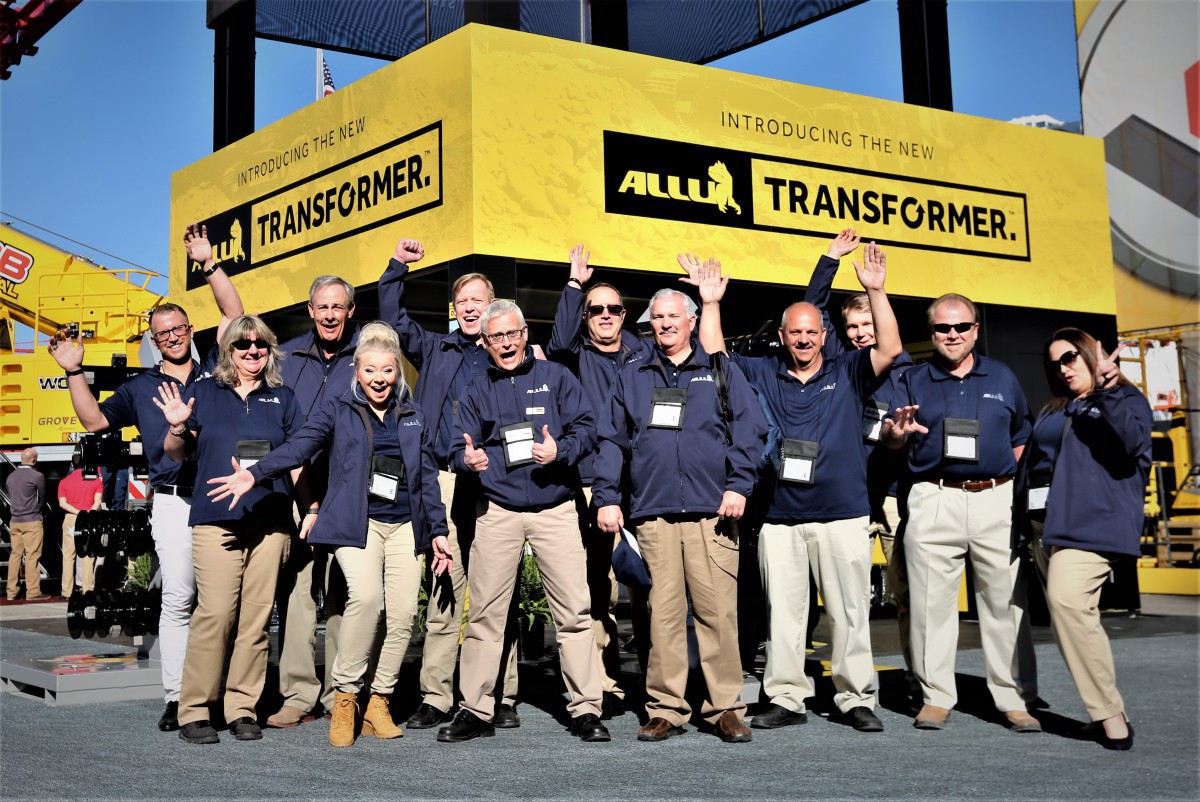
ALLU will be exhibiting equipment from its Transformer, Processor and other equipment ranges at ConExpo/ConAGG 2020 in the Central Hall. With a theme of “Transforming the way you work”, ALLU will show how its transforming efficiency, transforming profitability and transforming green credentials are achieved through transforming equipment and operations.
ALLU will be using the show to exhibit leading members of its ranges, outline new features of the equipment and launch its latest developments aimed at further enhancing customer business operations.
Transforming the Way You Work
At the heart of the ALLU offering is a business focus based on “Transforming the way you work”. This essentially translates into efficiency through the solution being a one-stop-shop process enabling the screening, crushing, aerating, mixing and loading all in a one-step operation. This also enables the transforming of profitability as less material goes to landfill resulting in less expenditure in haulage costs and landfill fees. The re-use of material on site also means that there is no need to purchase virgin material due to the recycling and utilization of left over materials and the generation of an income from it.
Additionally, ALLU equipment is focused on businesses transforming their green credentials, as less material transported to the job site means a reduction in fuel consumption, less material to landfill and the greater efficient utilization of waste materials leading to the support of sustainability. Vitally, this is accomplished as ALLU equipment helps transform any carrier — excavator, wheel loader, skid steer etc — into a multifunctional tool that will screen, crush, mix, aerate, pulverize and load all in a one-step operation.
In order to both show the breadth of the offering, and to show at first-hand how ALLU is able to help transform the way businesses work, the following equipment will be exhibited at the show:
ALLU Transformer DL 2-09 with 8 mm TS blades (the thinnest blade model)
ALLU Transformer DH 3-17 with 16/32 TS blades
ALLU Transformer DH 4-17 with 25/50 TS blades
ALLU Transformer M 3-20 with 50 mm TS blades
ALLU Processor 300HD
The TS blade structure has been developed by ALLU, which has long been a pioneer in developing techniques of this kind. The TS blades are a modern development for the screener / crusher market, with ALLU set to deliver new levels of efficiency and productivity with the new blade variations. This new blade structure also will further enable customers to utilize their ALLU Transformer in more ways, according to the manufacturer.
The ALLU Processor is a power mixer attachment that converts any excavator into a powerful and versatile mixing tool capable of penetrating and effectively mixing a variety of difficult materials.
Materials suited for the attachment range from clay, silt, peat, sludge and sediment, to dredged material and contaminated soil. Fitted to, and powered by the excavator’s hydraulic system, and benefitting from its ability to reach difficult or soft areas, the Processor 300 HD is able to mix materials everywhere the excavator goes. This means that binders or chemical agents can be delivered to the area of the highest mixing shear by an attached 80mm diameter pipe, and injected via a nozzle located between the mixing drums.
ALLU to feature multiple lines at ConExpo-Con/Agg 2020
03/01/2021
Allu will display equipment from its Transformer and Processor lines at ConExpo-Con/Agg 2020. Photo courtesy of Allu
Allu will feature a range of equipment at ConExpo-Con/Agg in Las Vegas, including the company’s Transformer and Processor, at its Central Hall booth (C20326) at the Las Vegas Convention Center.
Allu’s show display will include the Transformer DL 2-0 with 8-mm TS blades; the Transformer DH 3-17 with 16/32 TS blades; the Transformer DH 4-17 with 25/50 TS blades; the Transformer M 3-20 with 50-mm TS blades; and the Processor 300HD.
According to the company, the TS blades are a modern development for the screening and crushing market and will further enable customers to utilize their Allu Transformer in numerous ways.
The Allu Processor, on the other hand, is a power mixer attachment that converts any excavator into a versatile mixing tool that can penetrate and mix difficult materials, including clay, silt, peat, sludge and sediment, dredged material and contaminated soil.
The Processor 300HD is fitted to and powered by the excavator’s hydraulic system and benefits from the machine’s ability to reach difficult or soft areas, according to Allu. In addition, because the attachment is able to mix materials everywhere the excavator goes, binders or chemical agents can be delivered to the area of highest mixing shear via an attached 80-mm-diameter pipe and injected via a nozzle located between the mixing drums.
Lahti Ring Road Landscape Transformed with Help from Allu
03/01/2021
A series of 167 improvements are currently underway around the southern ring road of the Finnish city of Lahti. One of the main contractors for the project, Skanska, has added a new tool to its armory in making the work as efficient, cost effective and environmentally friendly as possible. Allu DN Series Transformers have been successfully put to work screening excavated materials for reuse on the project thereby boosting the environmental credentials and efficiency of the project.
The southern ring road around the Finnish city of Lahti (Finnish national road 12) will when complete boost to the area’s economy with the project acting as a driver for industrial growth through improvements to the general traffic flow. At the same time, the ring road project is seen as of great strategic importance to the entire traffic system of Finland as it substantially improves cross country connections and links to St. Petersburg in Russia that are vital to Finnish industry.
“The road project will unambiguously bring growth and well-being to Lahti: jobs, apartments and better opportunities for entrepreneurs. Lahti’s competitiveness will improve significantly and the operating conditions of the basic industry will be strengthened under the influence of Finnish national road 12. We are very happy and thankful for this decision,” says City Board President Juha Rostedt of the project.
“Building the ring road to the south side of Lahti is a significant investment in the development of Lahti. We are ready to begin the project and will utilize the ring road to the fullest for the environment, the business sector and the job market,” added Lahti’s mayor Jyrki Myllyvirta.
Background to the development
The Lahti Southern Ring Road project involves rerouting the main road No 12 to the south of Lahti and improving the regional road No 167, which enters Lahti from the south. Main road No 12 is a major national east–west route, with the road currently running through the center of Lahti and the built-up areas of Hollola.
The development and infrastructure project consists of two works sites and three separate contracts. Subproject 1A involves widening the Lahti Southern Ring Road at the Hollola end to provide two lanes along main road No 12 between Soramäki and Okeroinen, as well as building 17 bridges. Subproject 1B covers the southern end of the Lahti Southern Ring Road, with work starting to the east of the Okeroinen interchange and ends at the Joutjärvi interchange. This is a technically challenging stretch of the road, and the project involves, among other works, building several interchanges as well as two tunnels.
Subproject 2 involves widening Uudenmaankatu to provide four lanes along regional road No 167, which enters Lahti from the south, between Renkomäki and Laune. The project also involves renovating underpasses and bridges. Works along regional road No 167 began in the spring of 2017 and works along main road No 12 in the spring of 2018. The goal is to reopen main road No 12 to traffic towards the end of 2020, with work finishing in 2021, and final surfacing is scheduled for 2023.
Objectives of the project
The rerouting of No 12 main road further south will improve traffic safety and flow considerably, as it will divert traffic away from the centres of Lahti and Hollola. Quality of life will improve in residential areas once traffic is diverted, and lower traffic volumes will mean lower noise levels, emission levels and congestion in the surroundings of the current route of main road. In addition, safer and smoother traffic flow will also improve the reliability of goods transport to the increasingly important Lahti business hub.
From the perspective of land use development, the Lahti Southern Ring Road will provide new opportunities for developing the area around Lahti railway station, the former plot of the Asko furniture factory, the Sopenkorpi district and the center of Hollola. The bypass will promote the development of the Nostava logistics park and create efficient transport links to the Kujala and Lotila industrial parks. The rerouting of the main road No 12 further south will also reduce the risk of groundwater contamination in the Salpausselkä area, which is an extremely important source of groundwater.
Ground works and landscaping
Given that the project has impressive environmental credentials that will not only improve the infrastructure, but will also lead to a higher quality of life for residents, the way excavated materials are treated has been an important concern on all the subprojects. One of the main contractors, Skanska Infra Oy, has been using Allu DN Series Transformers for landscape purposes, helping to create noise reducing embankments and to mix soil for planting. The Allu Transformer has proved perfect for the tasks at hand dealing with soils and other excavated material, being highly mobile enabling it to go directly to where it is needed. This has meant that there has been no need for transporting material to and from site thus further lowering emissions and reducing costs.
As part of its work on the ring road project, Skanska Infra Oy, is responsible for landscaping and constructing road slopes, embankments and noise barriers. To this end the Allu DN 3-17 X75 has proved to be invaluable. This is a screening attachment for compact base machines, being suited for excavators up to 28t, loaders-tractors and backhoe loaders up to 14t. The entire DN series is ideal for large landscaping projects, as it offers a truly mobile solution, providing high levels of working versatility and flexibility even in the most challenging environments.
The Allu Transformer comprises of an attachment which screens, crushes, aerates, blends, mixes, separates, feeds and loads materials. This results in the feed material being effectively transformed into highly valuable products, making operations on the project more efficient, and more profitable. At the heart of the Transformer is the unique top screen of its bucket. This is where the screening blades spin between the top screen combs with the end material size being defined by the space between the combs. Effectively these screening combs carry most of the material weight to ensure the drums and bearings take on less impact and load. This construction is clog free and maintains good capacity even with wet materials.
The use of the Allu Transformer has been pivotal on the ground works and landscaping operation on the southern ring road project. Following excavation the material is collected and its usability is analysed, then screened and mixed using the Transformer to provide a smooth soil mixture. After that, the ready to use soil is spread where it is required, ready for any planting. In the latter case, the construction of sight and noise barriers, as well as reaffirming the environmental credentials of the project, sees reforestation as a key part of the project. This all means that the use of the Allu Transformers sees material being reused from excavation operations, with no requirement to buy or transport extra material from outside the project, which is inefficient, both economically and environmentally.
The capabilities of the ALLU range of Transformers are being seen firsthand in North America. Here, two companies (one in Wisconsin and the other in Canada) have invested in a D-Series attachment. The processing power of the Transformer has proven to be particularly effective in dredging a river and reducing tree bark for recycling respectively.
The ALLU Transformer series comprises of an excavator/loader/tractor mounted processing attachment which screens, pulverizes, aerates, blends, mixes, separates, crushes, feeds and loads materials. This results in the feed material being effectively transformed into highly valuable products, making any business more efficient, and more profitable.
Catering for applications of all sizes, and capable of processing any material that can be screened and sorted, the ALLU Transformer series comprises of the compact DL & D Series as well as the truly massive M and G Series. All are designed to transform the way in which material handling and processing businesses are able to improve their efficiency and profitability.
The ALLU Transformer, whatever its size and configuration, is ideal for recycling, processing concrete, waste, soil, sand, tree derived materials, rocks and minerals, as it also aerates, as well as screening, loads and crushes, all of which can be carried out on site. This truly mobile solution provides the versatility and flexibility to enable work to be accomplished more efficiently even in the most challenging environments. This results in substantial savings in material and transport costs, as no time is lost when waiting for replacement material.
Dredging in Wisconsin
One such application where the versatility, productivity and efficiency of the Transformer has proved itself is in Wisconsin. Here an ALLU DH 3-17 Transformer is being used to remove 600 mm of soil from a navigable river. The Transformer is mounted on a John Deere 470 excavator with a long reach configuration, with a position and angle sensor being mounted to the Transformer so that the operation can be observed on a monitor in the cab of the excavator. A dredge pump for the operation is able to receive material up to 75 mm, with the Transformer removing rocks and other debris without unnecessary downtime.
Recycling in Canada
In Nova Scotia, Canada, another DH 3-17 Transformer is currently being used to separate board material from sawdust, and to crush tree bark. The Transformer solution has proved to be an efficient attachment for the job, as it has replaced the stationary processing equipment, which required expensive maintenance as it aged. The Transformer requires fewer people at the work site due to higher utilization, resulting directly in fewer pieces of machinery being needed on site.
Transforming Operations
At the heart of both the examples above is the ALLU Transformer DH with its unique top screen. Here the screening blades spin between the top screen combs with the end material size being defined by the space between the combs. Effectively these screening combs carry most of the material weight to ensure the drums and bearings take on less impact and load. This construction is clog-free and maintains good capacity even with wet materials (especially useful when dealing with dredged material in Wisconsin).
ALLU held a meeting of its global dealer network during the second week of February, with close to 100 representatives from ALLU dealerships coming to Finland for the occasion.
The company has placed a great deal of emphasis over the last few years in growing its professional dealer and distributor network. Throughout Europe, Latin America, Africa, the US and increasingly SE Asia, the network has continued to grow, enabling customers throughout the world to benefit from the unique attributes of the ALLU Transformer and Processor ranges.
In order to provide customers with the very latest developments in ALLU’s increasing solutions portfolio, close to 100 ALLU distributors came to Finland from 13-16 February. During the meeting, the dealers enjoyed a series of events aimed at providing them with the latest developments and application thinking concerning the ALLU product lines.
In addition to seminars, workshops and a highly informative walk-through of the production process, ALLU product and service experts were also on-hand to provide advice in order to help the dealers assist their customers maximise their investments.
“The dealer conference and meeting was the perfect occasion for me to meet the ALLU people in the field,” said ALLU vice president of sales Jeroen Hinnen. “I thought it was an excellent occasion, enabling us at ALLU to not only help our partners, but also to listen to what they and their customers want from ALLU.”
At a gala dinner held on the last night of the meeting, an awards ceremony was held to recognise the performance of ALLU’s dealers. Tianjin Deal Electronic and Mechanical Equipment Trading Company Ltd from China was presented with ‘dealer of the year’, with R D Williams from Australia being awarded the ‘ALLU award for excellence’. Finally, newly appointed dealer, Murray Plant from the UK, was given the ‘best performing new dealer’ award.
“Our dealers are vital link between us and the customers. And the dealer’s performance has been outstanding in 2018,” said ALLU president Ola Ulmala. “The ALLU awards recognise how well our dealers are performing, providing customers with outstanding solutions wherever they are in the world.”
The dealer meeting is one of a series of events ALLU intends to hold throughout 2019 aimed at helping its dealers help their customers. Service workshops are scheduled throughout the world, as are application seminars.
The recent global dealer network meeting held by Finnish crushing and screening hydraulic bucket attachment maker ALLU attracted close to 100 representatives. During the meeting the dealers were given a series of seminars, workshops and a walk-through of the production process aimed at providing them with the latest developments and application thinking concerning the ALLU product lines such as Transformer and Processor. From left: Gang Xiao, Tianjin Deal Electronic and Mechanical Equipment Trade Company (ALLU dealer of the year); Jeroen Hinnen, VP sales, ALLU Group; Baojian Wang, president, ALLU China
The recent global dealer network meeting held by Finnish crushing and screening hydraulic bucket attachment maker ALLU attracted close to 100 representatives.
During the meeting the dealers were given a series of seminars, workshops and a walk-through of the production process aimed at providing them with the latest developments and application thinking concerning the ALLU product lines such as Transformer and Processor.
ALLU has recently placed great deal emphasis on growing its dealer and distributor network throughout Europe, Latin America, Africa, the US and increasingly SE Asia, the network has continued to grow enabling customers throughout the world to easily benefit from the unique attributes of the ALLU Transformer and Processor ranges.
At a gala dinner held on the last night of the meeting, an awards ceremony was held to recognise the outstanding performance of ALLU’s dealers. Tianjin Deal Electronic and Mechanical Equipment Trading Company Ltd from China was presented with ‘dealer of the year’, with R D Williams from Australia being awarded the ‘ALLU award for excellence’. Finally, newly appointed dealer, Murray Plant from the UK, was given the ‘best performing new dealer’ award.
“Our dealers are vital link between us and the customers. And the dealer’s performance has been outstanding in 2018,” said ALLU president Ola Ulmala. “The ALLU awards recognise how well our dealers are performing, providing customers with outstanding solutions wherever they are in the world.”
The dealer meeting is one of a series of events ALLU intends to hold throughout 2019 aimed at helping its dealers help their customers. Service workshops are scheduled throughout the world, in addition to application seminars.
As part of an effort to improve water quality and restore the Raritan Canal’s original carrying capacity, crews in New Jersey are relying on ALLU equipment to carry out the crucial work of sediment amendment with Portland cement. (Brennan photo)
Dredging has resumed in the Delaware and Raritan Canal, with the current season expected to run through the end of October. As of May 1, the canal was closed to boaters between the Walking Bridge and Griggstown Lock, to accommodate work in Reach 3. The next segment to be dredged in 2019 will be Reach 5 from July to October, between Griggstown Causeway and Blackwells Mills Causeway.
“The canal functions as a means to transport water and as a reservoir, and is part of the Raritan basin water supply system, providing source water to millions of central New Jersey residents,” said Julie Shelley, property and permit administrator of the New Jersey Water Supply Authority (NJWSA), which is responsible for maintaining the canal. “One hundred million gallons per day is diverted from the Delaware River to the canal. Dredging will improve water quality and restore the canal’s original carrying capacity by removing accumulated sediment, aquatic vegetation growth and debris.”
A more than 10-mi. section is being dredged, located between Route 27 (Kingston) and Amwell Road (East Millstone), all within Franklin Township, Somerset County.
“The canal is 60 miles long, and this stretch of it has never been dredged in the 82 years that the state of New Jersey has owned it. The canal’s storage capacity in this stretch has become hampered as a result of the accumulated sediment and associated aquatic vegetation growth.”
According to the NJWSA website, the canal is fed by the Delaware River and smaller streams, channels and other runoff sources. Sediment from road and land runoff is deposited in the canal, decreasing its water storage capacity. Periodically, the sediment needs to be removed to restore the canal’s original capacity.
“Executing a big project like this in the midst of all the complexities associated with the ‘construction site’ is quite a challenge,” said Shelley. “So far, approximately one third of the project has been completed. Three-and-a-half miles out of 10.5 miles have been successfully dredged.”
According to Sharmila Rahman, NJWSA project engineer, site preparation began in March 2018, with tree clearing/trimming at the staging area and five access areas, where dredges are placed into the canal with a crane.
“In-water work, which includes removal of submerged aquatic vegetation, debris and dredging, began in July of 2018. We expect three years of seasonal dredging activities and full completion of the project by the beginning of 2021.”
Rahman said the logistics of the undertaking require year-round work and oversight.
“After the 2018 dredging season, which ended in November, produced 50,000 cubic yards, or 76,000 tons, of sediment, the material was allowed to dewater for a period of time. The material needed to be mixed with cement to reduce the moisture content and improve handling for the end-user before it could be hauled.”
Hauling began in December 2018, and continued through the end of March, followed by preparation for the next dredging season.
As far as the biggest challenges on the project, said Rahman, “The timing restrictions for different species have created short windows for specific operations. The dredging window is so constrained that any unforeseen situation, especially weather, could delay the project.”
The most time-consuming part of the work involves hydraulic dredging. It is a slow process, with only 100 linear ft. of canal per day per dredge accomplished, on average. As part of the work, sediment is amended with Portland cement and trucked to an offsite facility for reuse, with the drained water returned to the canal after treatment.
“It takes four to six weeks for sediment to dewater,” said Rahman. “The geotextile sediment storage bags are then cut open and cement is then added to the sediment with an ALLU system that conveys dry Portland cement from the silo to the sediment and also mixes the cement with the sediment at the same time. After mixing in the cement, the sediments are loaded with excavator mounted clam shell buckets into triaxle dump trucks. This past winter approximately 2,700 dump truck loads transported 76,000 ton of amended sediment off site.”
The canal is listed on the National and State Registers of Historical Places, requiring NJWSA to engage a cultural resource consultant to monitor the project.
“The canal itself is a historical structure, and the associated structures along the canal also are historic. The dredging project was designed to protect all of the historical structures from any adverse impact. For example, to protect sections of the embankment still lined with historic stone armoring, dredging is not allowed within five feet of the embankment walls.
“Further, the dredge is not allowed to operate within ten feet of any known historic structures. In addition, the dredge operators were all trained in how to monitor for historic artifacts, and how to preserve if any artifacts were found during the dredging.”
“It is a unique project, which involves engineers, environmentalists, cultural resource consultants and construction managers,” said Marc Brooks, NJWSA chief engineer, who noted that the original canal prism was constricted to the point where it was negatively affecting the ability to transfer water.
The design called for approximately 248,000 cu. yds. of material to be dredged from the canal.
“Cranes are used to place the dredges and floating barges with excavators into the canal,” said Brooks. “The barge mounted excavators are used ahead of the dredging operation to remove subaqueous vegetation and debris. Dredges are used to remove the sediment from the canal.”
To build the staging and sediment dewatering area, approximately 33,000 cubic yards of soil and weathered bedrock were handled to create a shallow sloping dewatering pad on the side of a hill, which included import of 27,000 tons of gravel for geobags to be placed on and helps convey water to the settling sumps.
“Geotextile and an HDPE liner was used to cover the entire eight-acre staging area, and create an impervious barrier to contain the water after draining from the geobags that contain the dredged sediment,” said Brooks.
Slurry is conveyed via booster pumps and floating pipes to the geo-textile dewatering bags. Before entering the bags, polymer dosages are applied to expedite flocculation and coagulation of the sediments in the geobags.
“All the drain water from the geobags is collected in dewatering sumps,” said Brooks. “At the sumps, ferric chloride is applied to the collected water, so that the rest of the sediment in the drained water can settle out in the sumps. Then the water is pumped back to the canal from the sumps via a 75 hp pump and discharge pipe.”
During periods of active dredging, the portion of the canal being dredged is shutdown to boaters, although it was only closed during the tree trimming that lasted for roughly a week, but generally not more than 1,000 ft. at a time.
All the maintenance work, mobilization and demobilization of barges, dredges and pumps was accomplished from the access areas, which are situated on the opposite side of the canal from the towpath. Based on an agreement with Franklin Township, trucks are only allowed to haul material in the immediate vicinity of the staging area after the morning rush hour and before the evening rush. All trucking near the staging area must take place from 9:00 a.m. until 3:30 p.m., Monday through Friday only.