Raritan Canal Receives Much-Needed Dredge

As part of an effort to improve water quality and restore the Raritan Canal’s original carrying capacity, crews in New Jersey are relying on ALLU equipment to carry out the crucial work of sediment amendment with Portland cement.
(Brennan photo)
As part of an effort to improve water quality and restore the Raritan Canal’s original carrying capacity, crews in New Jersey are relying on ALLU equipment to carry out the crucial work of sediment amendment with Portland cement. (Brennan photo)

Dredging has resumed in the Delaware and Raritan Canal, with the current season expected to run through the end of October. As of May 1, the canal was closed to boaters between the Walking Bridge and Griggstown Lock, to accommodate work in Reach 3. The next segment to be dredged in 2019 will be Reach 5 from July to October, between Griggstown Causeway and Blackwells Mills Causeway.

“The canal functions as a means to transport water and as a reservoir, and is part of the Raritan basin water supply system, providing source water to millions of central New Jersey residents,” said Julie Shelley, property and permit administrator of the New Jersey Water Supply Authority (NJWSA), which is responsible for maintaining the canal. “One hundred million gallons per day is diverted from the Delaware River to the canal. Dredging will improve water quality and restore the canal’s original carrying capacity by removing accumulated sediment, aquatic vegetation growth and debris.”

A more than 10-mi. section is being dredged, located between Route 27 (Kingston) and Amwell Road (East Millstone), all within Franklin Township, Somerset County.

“The canal is 60 miles long, and this stretch of it has never been dredged in the 82 years that the state of New Jersey has owned it. The canal’s storage capacity in this stretch has become hampered as a result of the accumulated sediment and associated aquatic vegetation growth.”

According to the NJWSA website, the canal is fed by the Delaware River and smaller streams, channels and other runoff sources. Sediment from road and land runoff is deposited in the canal, decreasing its water storage capacity. Periodically, the sediment needs to be removed to restore the canal’s original capacity.

“Executing a big project like this in the midst of all the complexities associated with the ‘construction site’ is quite a challenge,” said Shelley. “So far, approximately one third of the project has been completed. Three-and-a-half miles out of 10.5 miles have been successfully dredged.”

According to Sharmila Rahman, NJWSA project engineer, site preparation began in March 2018, with tree clearing/trimming at the staging area and five access areas, where dredges are placed into the canal with a crane.

“In-water work, which includes removal of submerged aquatic vegetation, debris and dredging, began in July of 2018. We expect three years of seasonal dredging activities and full completion of the project by the beginning of 2021.”

Rahman said the logistics of the undertaking require year-round work and oversight.
“After the 2018 dredging season, which ended in November, produced 50,000 cubic yards, or 76,000 tons, of sediment, the material was allowed to dewater for a period of time. The material needed to be mixed with cement to reduce the moisture content and improve handling for the end-user before it could be hauled.”

Hauling began in December 2018, and continued through the end of March, followed by preparation for the next dredging season.

As far as the biggest challenges on the project, said Rahman, “The timing restrictions for different species have created short windows for specific operations. The dredging window is so constrained that any unforeseen situation, especially weather, could delay the project.”

The most time-consuming part of the work involves hydraulic dredging. It is a slow process, with only 100 linear ft. of canal per day per dredge accomplished, on average. As part of the work, sediment is amended with Portland cement and trucked to an offsite facility for reuse, with the drained water returned to the canal after treatment.

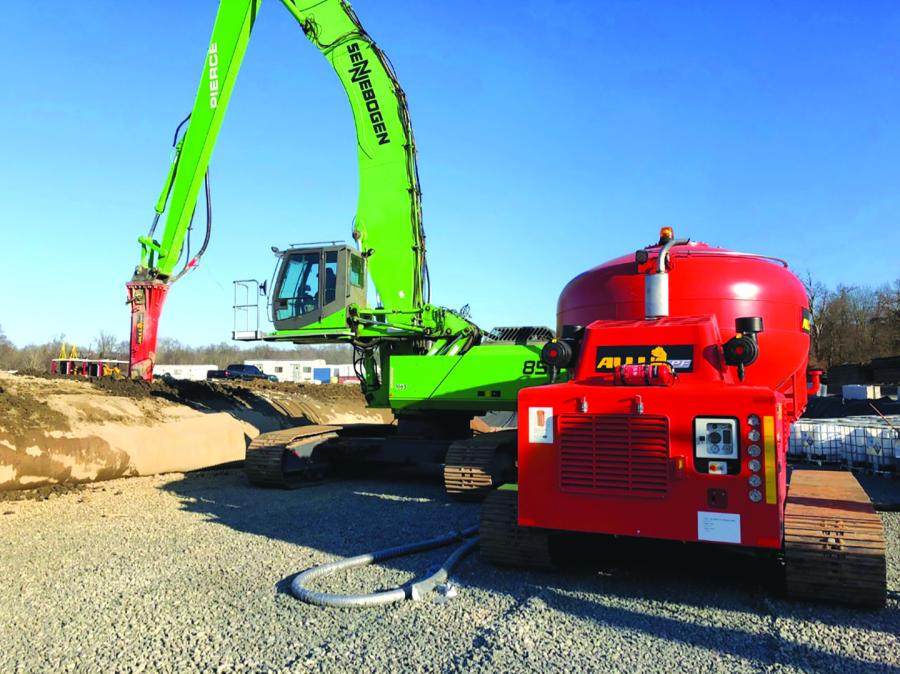
“It takes four to six weeks for sediment to dewater,” said Rahman. “The geotextile sediment storage bags are then cut open and cement is then added to the sediment with an ALLU system that conveys dry Portland cement from the silo to the sediment and also mixes the cement with the sediment at the same time. After mixing in the cement, the sediments are loaded with excavator mounted clam shell buckets into triaxle dump trucks. This past winter approximately 2,700 dump truck loads transported 76,000 ton of amended sediment off site.”

The canal is listed on the National and State Registers of Historical Places, requiring NJWSA to engage a cultural resource consultant to monitor the project.

“The canal itself is a historical structure, and the associated structures along the canal also are historic. The dredging project was designed to protect all of the historical structures from any adverse impact. For example, to protect sections of the embankment still lined with historic stone armoring, dredging is not allowed within five feet of the embankment walls.

“Further, the dredge is not allowed to operate within ten feet of any known historic structures. In addition, the dredge operators were all trained in how to monitor for historic artifacts, and how to preserve if any artifacts were found during the dredging.”

“It is a unique project, which involves engineers, environmentalists, cultural resource consultants and construction managers,” said Marc Brooks, NJWSA chief engineer, who noted that the original canal prism was constricted to the point where it was negatively affecting the ability to transfer water.

The design called for approximately 248,000 cu. yds. of material to be dredged from the canal.

“Cranes are used to place the dredges and floating barges with excavators into the canal,” said Brooks. “The barge mounted excavators are used ahead of the dredging operation to remove subaqueous vegetation and debris. Dredges are used to remove the sediment from the canal.”

To build the staging and sediment dewatering area, approximately 33,000 cubic yards of soil and weathered bedrock were handled to create a shallow sloping dewatering pad on the side of a hill, which included import of 27,000 tons of gravel for geobags to be placed on and helps convey water to the settling sumps.

“Geotextile and an HDPE liner was used to cover the entire eight-acre staging area, and create an impervious barrier to contain the water after draining from the geobags that contain the dredged sediment,” said Brooks.
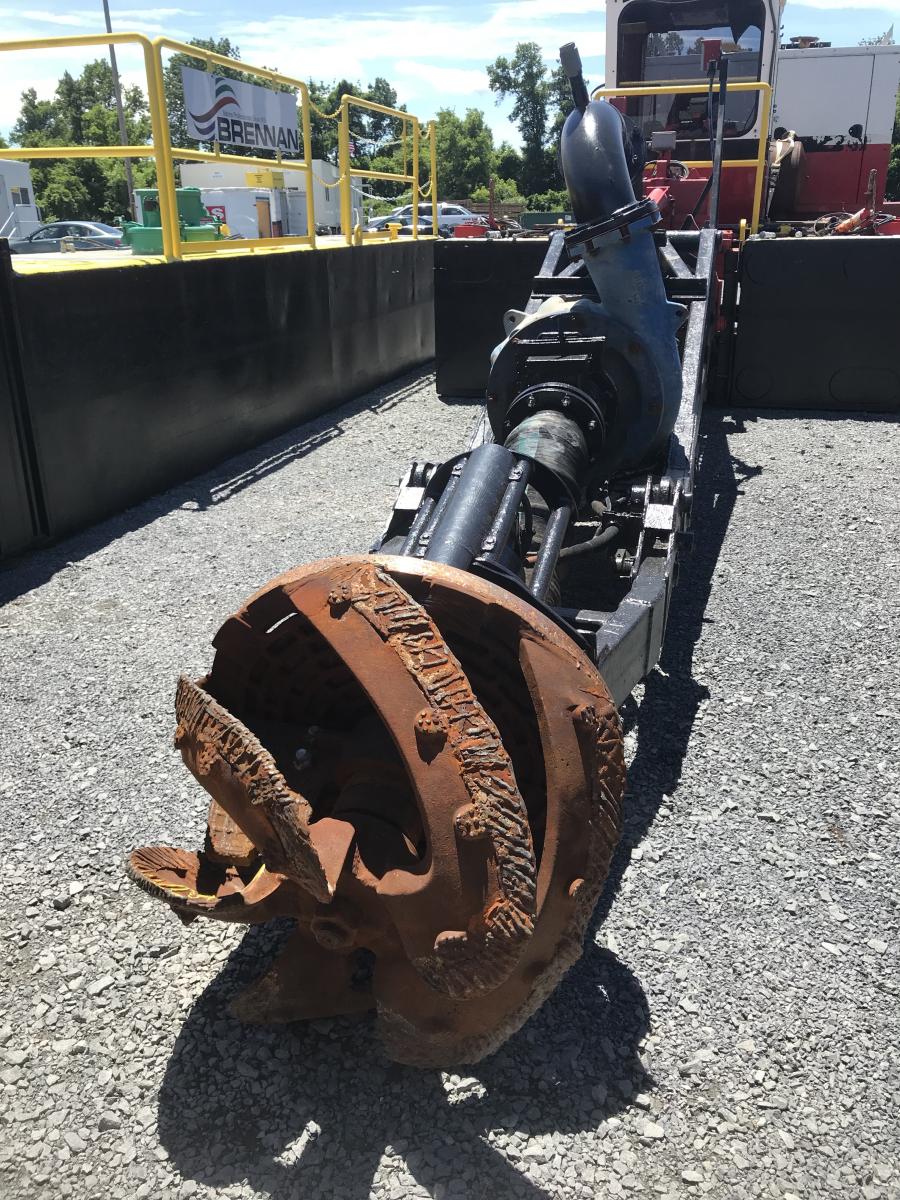
Slurry is conveyed via booster pumps and floating pipes to the geo-textile dewatering bags. Before entering the bags, polymer dosages are applied to expedite flocculation and coagulation of the sediments in the geobags.

“All the drain water from the geobags is collected in dewatering sumps,” said Brooks. “At the sumps, ferric chloride is applied to the collected water, so that the rest of the sediment in the drained water can settle out in the sumps. Then the water is pumped back to the canal from the sumps via a 75 hp pump and discharge pipe.”

During periods of active dredging, the portion of the canal being dredged is shutdown to boaters, although it was only closed during the tree trimming that lasted for roughly a week, but generally not more than 1,000 ft. at a time.

All the maintenance work, mobilization and demobilization of barges, dredges and pumps was accomplished from the access areas, which are situated on the opposite side of the canal from the towpath. Based on an agreement with Franklin Township, trucks are only allowed to haul material in the immediate vicinity of the staging area after the morning rush hour and before the evening rush. All trucking near the staging area must take place from 9:00 a.m. until 3:30 p.m., Monday through Friday only.

(CEG Editor in Chief Craig Mongeau contributed to this article.) CEG

Nearly 100 attend ALLU global dealer meeting

The recent global dealer network meeting held by Finnish crushing and screening hydraulic bucket attachment maker ALLU attracted close to 100 representatives. During the meeting the dealers were given a series of seminars, workshops and a walk-through of the production process aimed at providing them with the latest developments and application thinking concerning the ALLU product lines such as Transformer and Processor. ALLU has recently placed great deal emphasis on growing its dealer and distributo

ALLU dealer meeting 2.jpg
From left: Gang Xiao, Tianjin Deal Electronic and Mechanical Equipment Trade Company (ALLU dealer of the year); Jeroen Hinnen, VP sales, ALLU Group; Baojian Wang, president, ALLU China

The recent global dealer network meeting held by Finnish crushing and screening hydraulic bucket attachment maker ALLU attracted close to 100 representatives.

During the meeting the dealers were given a series of seminars, workshops and a walk-through of the production process aimed at providing them with the latest developments and application thinking concerning the ALLU product lines such as Transformer and Processor.

ALLU has recently placed great deal emphasis on growing its dealer and distributor network throughout Europe, Latin America, Africa, the US and increasingly SE Asia, the network has continued to grow enabling customers throughout the world to easily benefit from the unique attributes of the ALLU Transformer and Processor ranges.

At a gala dinner held on the last night of the meeting, an awards ceremony was held to recognise the outstanding performance of ALLU’s dealers. Tianjin Deal Electronic and Mechanical Equipment Trading Company Ltd from China was presented with ‘dealer of the year’, with R D Williams from Australia being awarded the ‘ALLU award for excellence’.  Finally, newly appointed dealer, Murray Plant from the UK, was given the ‘best performing new dealer’ award.

“Our dealers are vital link between us and the customers. And the dealer’s performance has been outstanding in 2018,” said ALLU president Ola Ulmala. “The ALLU awards recognise how well our dealers are performing, providing customers with outstanding solutions wherever they are in the world.”

The dealer meeting is one of a series of events ALLU intends to hold throughout 2019 aimed at helping its dealers help their customers. Service workshops are scheduled throughout the world, in addition to application seminars.

ALLU holds global dealer meeting

ALLU held a meeting of its global dealer network during the second week of February, with close to 100 representatives from ALLU dealerships coming to Finland for the occasion.

The company has placed a great deal of emphasis over the last few years in growing its professional dealer and distributor network. Throughout Europe, Latin America, Africa, the US and increasingly SE Asia, the network has continued to grow, enabling customers throughout the world to benefit from the unique attributes of the ALLU Transformer and Processor ranges.

In order to provide customers with the very latest developments in ALLU’s increasing solutions portfolio, close to 100 ALLU distributors came to Finland from 13-16 February. During the meeting, the dealers enjoyed a series of events aimed at providing them with the latest developments and application thinking concerning the ALLU product lines.

In addition to seminars, workshops and a highly informative walk-through of the production process, ALLU product and service experts were also on-hand to provide advice in order to help the dealers assist their customers maximise their investments.

“The dealer conference and meeting was the perfect occasion for me to meet the ALLU people in the field,” said ALLU vice president of sales Jeroen Hinnen. “I thought it was an excellent occasion, enabling us at ALLU to not only help our partners, but also to listen to what they and their customers want from ALLU.”

At a gala dinner held on the last night of the meeting, an awards ceremony was held to recognise the performance of ALLU’s dealers. Tianjin Deal Electronic and Mechanical Equipment Trading Company Ltd from China was presented with ‘dealer of the year’, with R D Williams from Australia being awarded the ‘ALLU award for excellence’. Finally, newly appointed dealer, Murray Plant from the UK, was given the ‘best performing new dealer’ award.

“Our dealers are vital link between us and the customers. And the dealer’s performance has been outstanding in 2018,” said ALLU president Ola Ulmala. “The ALLU awards recognise how well our dealers are performing, providing customers with outstanding solutions wherever they are in the world.”

The dealer meeting is one of a series of events ALLU intends to hold throughout 2019 aimed at helping its dealers help their customers. Service workshops are scheduled throughout the world, as are application seminars.

ALLU and MAPEI in concrete recycling co-operation

Concrete washout from a truckmixer

Companies working together to transform returned concrete into high-quality recycled aggregate  

ALLU MAPEI Circulus is a highly mobile and industrially efficient method for transforming returned concrete into a high-quality recycled aggregate. The system is aimed at large and medium-sized ready-mixed concrete producers or cement/concrete recycling companies who wish to reduce the costs associated with returned waste concrete. The system also greatly reduces the amount of wash-out sludge from concrete truckmixers.

According to ALLU and MAPEI, savings of up to tens of Euro’s per cubic metre of concrete produced are said to be achievable through reductions in both landfill costs and virgin aggregate costs.

The system itself is simple and requires minimal investment in MAPEI’s Re-con Zero chemical and an ALLU Transformer. Using Re-Con Zero, the returned wet concrete is transformed into a dry granulate, whereupon the ALLU Transformer is used to process the hardened lumps and screen them into specified aggregate sizes suitable for recycling in fresh concrete.

Concrete manufacturers can use between 5% and 30% of the recycled aggregate in new concrete, resulting in significant savings in production costs.

According to ALLU and MAPEI, the Circulus system can assist the concrete industry’s drive towards sustainability in concrete manufacturing. Global consumption of concrete is around 23 billion tonnes per year and it is estimated that approximately 2% of all concrete is returned to the producer, much of it ending up in landfill.

With an estimated 5% percent of all man-made CO2 emissions resulting from cement and concrete production, the 2% (460 million tonnes) of concrete that is produced and returned results in some 53 million tonnes of carbon dioxide emissons. With ALLU MAPEI Circulus, there is an opportunity to save up to 96% of these emissions.

ALLU and MAPEI are announcing their cooperation within concrete recycling

ALLU Transformer processing concrete

ALLU MAPEI Circulus* is a solution to transform returned concrete into a high-quality recycled aggregate. The immensely mobile and industrially efficient method has a strong impact on the environment and business. 

ALLU and MAPEI are both world class leading companies in their respective fields with global distribution networks. Through the cooperation customers will have access to the highest level of knowledge within concrete recycling.

The ALLU MAPEI Circulus system is aimed at large and medium sized RMC producers or cement/concrete recycling companies who wish to reduce the cost of handling returned concrete waste. Besides the positive environmental effects, through less new material needed, the system will generate substantial savings in production. Savings of up to tens of Euro’s per cubic meter of concrete produced are achievable through savings towards landfill cost and reduced costs for virgin aggregate.

ALLU Transformer and MAPEI Concrete Recycling

The system is simple and requires minimal investments: the MAPEI Re-con Zero- chemical and an ALLU Transformer. With Re-Con Zero the wet returned concrete is transformed into a dry granulate. The ALLU Transformer then processes the hardened lumps and screens them into the specified aggregate size to be recycled with fresh concrete. A concrete manufacturer may then use between 5% and 30% of the recycled aggregate with new concrete. This will bring significant savings to the cost of buying virgin aggregate. The system also greatly reduces the amount of washed out sludge from concrete trucks. Waste sludge is an environmental challenge as it must go to a landfill and is therefore an additional cost for concrete producers.

The ALLU MAPEI Circulus system assists the concrete industry towards sustainability in concrete manufacturing. The global consumption of concrete is a staggering 23 Billion tons per year, and it is estimated that approximately 2% of all concrete produced in the world is returned to the producer. The majority of this ends up on a landfill. An estimated five (5%) percent of all man-made carbon dioxide emissions stem from cement and concrete production. Two (2%) percent of produced and returned concrete adds up to 460 million tons being unnecessarily put on landfills, resulting in a staggering total of 53 million tons of carbon dioxide being emitted. With the ALLU MAPEI Circulus, there is an opportunity to save up to 96% on the above-mentioned CO2 emissions.

ALLU introduce new and upgraded mobile App

ALLU mobile app

New App utilizes Internet of Things technology to boost productivity, safety and customer service

ALLU have unveiled their new and upgraded mobile App featuring new functions aimed at helping to improve customers’ productivity and job site safety, whilst also providing enhanced customer service.

The latest version of the App provides an intelligent digital solution that allows customers and operators to obtain accurate and timely information regarding safe operations at job sites. The App accomplishes this whenever a mobile online service is available, through accessing information that is relevant to the serial number of the attachment.  

Using IoT technology, the ALLU App provides information about the working hours and the right angle of inclination with ALLU Transformer. Moreover, to maintain maximum productivity on site and minimize equipment downtime, the App provides information about the ideal maintenance frequency and the changing of wear parts, based on the working hours.

‘With these new features, the ALLU App allows more efficient customer service, now that the specific product information is also available for the customer,’ said ALLU support manager Jukka Parviainen.

The ALLU App provides instructions to guide the operator through safe working methods when using the ALLU attachment throughout the whole operating and ownership process.  The App also provides specific information about different job site applications and how best to utilize ALLU equipment, ensuring that the very best performance is obtained from the attachment. This is facilitated through accessing quick guides ranging from set-up, installation and operations, with the operating manual always being on hand.

Features and benefits of the ALLU App include:

  • Connects the serial number to relevant data
  • Matches the base machine (wheel loader or excavator) to the attachment being used
  • Notes specific applications to the model and correct working angle
  • Provides access to relevant pictures, videos and safety guide
  • Facilitates proactive servicing and maintenance
  • Links to closest ALLU dealer and ALLU Finland contact information
  • Allows access to operational and installation guides.

The ALLU App can be downloaded, free of charge, from the AppStore and PlayStore.

ALLU and MAPEI announce co-operation within concrete recycling

ALLU MAPEI Circulus is a solution to transform returned concrete into a high quality recycled aggregate. The immensely mobile and industrially efficient method has a strong impact on the environment and business.

ALLU and MAPEI are both world-class leading companies in their respective fields with global distribution networks. Through the co-operation customers will have access to the highest level of knowledge within concrete recycling.

The ALLU MAPEI Circulus system is aimed at large and medium-sized RMC producers or cement/concrete recycling companies who wish to reduce the cost of handling returned concrete waste. Besides the positive environmental effects, through less new material needed, the system will generate substantial savings in production. Savings of up to tens of euros per cubic metre of concrete produced are achievable through savings towards landfill cost and reduced costs for virgin aggregate.

The system is simple and requires minimal investments: the MAPEI Re-con Zero- chemical and an ALLU Transformer. With Re-Con Zero the wet returned concrete is transformed into a dry granulate. The ALLU Transformer then processes the hardened lumps and screens them into the specified aggregate size to be recycled with fresh concrete. A concrete manufacturer may then use between 5 – 30% of the recycled aggregate with new concrete. This will bring significant savings to the cost of buying virgin aggregate. The system also greatly reduces the amount of washed out sludge from concrete trucks. Waste sludge is an environmental challenge as it must go to a landfill and is therefore an additional cost for concrete producers.

The ALLU MAPEI Circulus system assists the concrete industry towards sustainability in concrete manufacturing. The global consumption of concrete is a staggering 23 billion tpy, and it is estimated that approximately 2% of all concrete produced in the world is returned to the producer. The majority of this ends up on a landfill. An estimated 5% of all man-made carbon dioxide emissions stem from cement and concrete production. 2% of produced and returned concrete adds up to 460 million t being unnecessarily put on landfills, resulting in a staggering total of 53 million t of carbon dioxide being emitted. With the ALLU MAPEI Circulus, there is an opportunity to save up to 96% on the above-mentioned carbon dioxide emissions.

ALLU unveils new TS blade structure at bauma 2019

ALLU used bauma 2019 to introduce its patented TS blade structure for its screener/ crusher bucket range. At the core of the ALLU TS drum construction is the configuration of the screening blades that spin between the screening combs. The end product size is defined by the space between the combs, and different fragment sizes can be achieved simply by repositioning the combs.

ALLU Transformer DN 3 17 TS processing demolition waste

As the screening combs carry most of the material weight, the drums and bearings experience less impact and load, with the design of the assembly ensuring the machine works well in wet and dry materials without clogging.

The ALLU TS drums are available with two different blade types: standard blades for screening applications and axe blades when a crushing or shredding effect is required. Blade sizes available include 16-32 mm, 25-50 mm and 35 mm.

The latest development enables several different fragment sizes from a single unit. Fragment size estimation is based on screening comb distance, with it being quick and easy to change from one screening job to another, providing more versatile processing.

ALLU introduces new app version at bauma 2019

The latest version of the ALLU mobile application (ALLU App), launched at bauma 2019, provides an intelligent digital solution for customers and operators. It allows them to obtain accurate and timely information regarding safe operations at jobsites, thereby maximising the use of their ALLU equipment.

ALLU introduces new app version at bauma 2019

The ALLU App provides information about working hours and the right angle of inclination with the ALLU Transformer. To maintain maximum productivity on site and to minimise equipment downtime, the app provides information about the ideal maintenance frequency and wear parts changing intervals, based on working hours.

“With these new features, the ALLU App enables more efficient customer service, now that the specific information of the product is also available for the customer,” says ALLU support manager, Jukka Parviainen.

The ALLU App provides instructions to guide the operator through safe working methods when using the ALLU attachment throughout the whole operating and ownership cycle. It also provides specific information about different jobsite applications, and how best to utilise ALLU equipment, ensuring that best performance from the attachment.

Bauma 2019 debut for ALLU’s TS blade structure

ALLU is introducing for the first time its patented TS blade structure for its screener/crusher bucket range.

At the core of the ALLU TS drum construction is the configuration of the screening blades that spin between the screening combs. The end product size is defined by the space between the comb, and different fragment sizes can be achieved simply by repositioning the combs.

As the screening combs carry most of the material weight, the drums and bearings experience less impact and load. The unit’s assembly design ensures the machine works well with wet and dry materials without clogging.

The ALLU TS drums are available with two different blade types: standard blades for screening applications and axe blades when a crushing or shredding effect is required. Blade sizes available include 16-32mm, 25-50mm and 35mm.

The latest development enables several different fragment sizes from a single unit. Fragment size estimation is based on screening comb distance, with it being quick and easy to change from one screening job to another, providing more versatile processing capabilities.